


How and why
A book which has had an outsized influence on my thinking has been Man’s Search for Meaning by Viktor Frankl. It is a thin book, and there are really only two primary ideas from it which have embedded themselves in my thinking, one of which Frankl quotes from Nietzsche. So to be entirely honest, I would have to say that there are two quotes from a short book written by Viktor Frankl which have had an outsized influence on me, and one of the quotes is not even his own. But nonetheless, I thought I might enjoy trying to lay out just how his work has affected me.
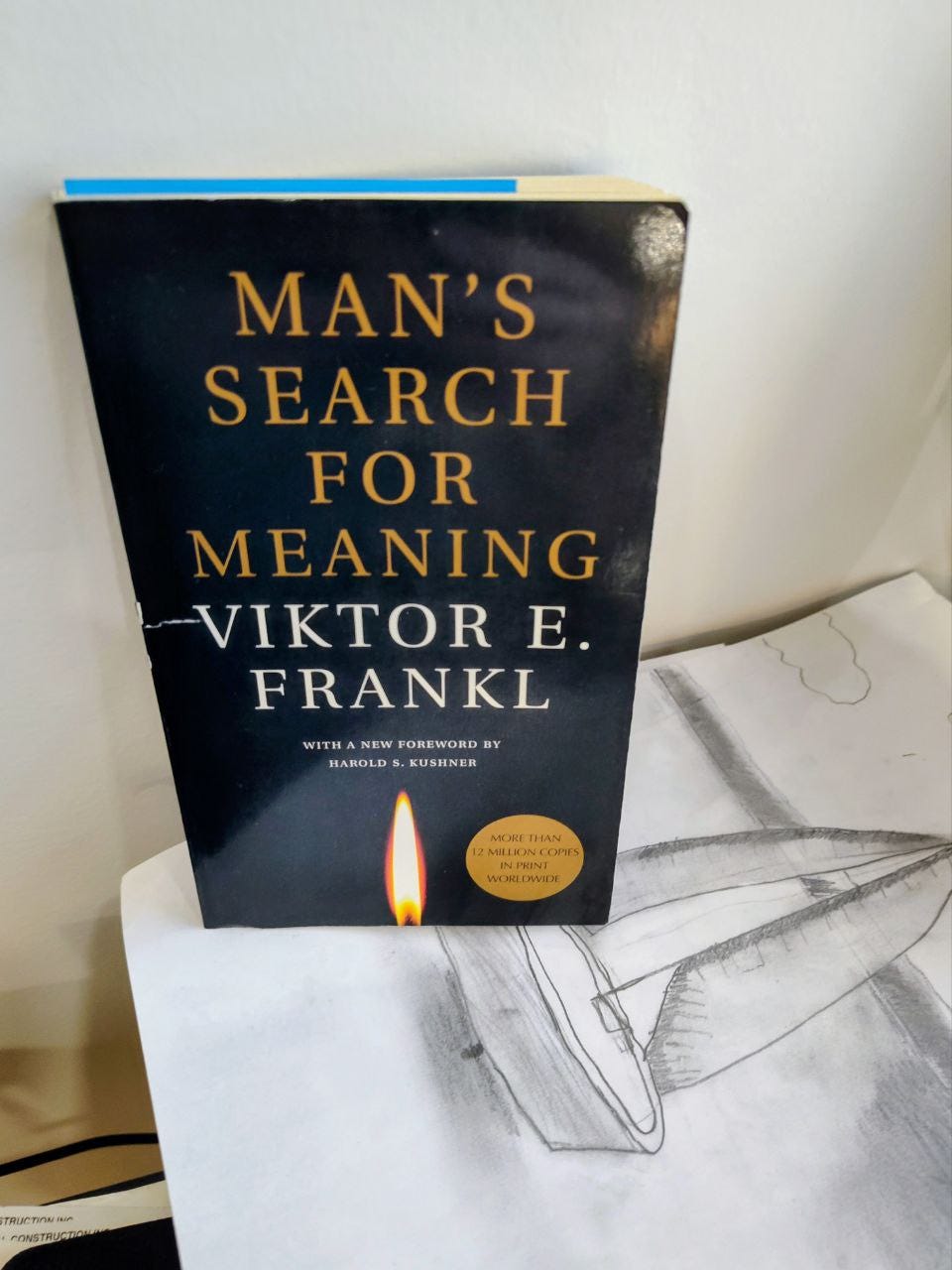
The Nietzsche quote which appears multiple times in Frankl’s book, is “He who has a why to live for can bear with almost any how.”1 To Frankl, the “how” that he had to “bear with” was not merely hypothetical, or the monotony of working a nine-to-five, or some other first world hardship. The “how” that he bore with was much more visceral: imprisonment, starvation, and overwork in a Nazi concentration camp. Not rush hour traffic but torture, frostbite, and ever-present death.
The why for which Frankl lived, was love. In an environment where many gave up on life, Frankl and a precious few others of his fellow inmates, discovered that
“a man who becomes conscious of the responsibility he bears toward a human being who affectionately waits for him, or to an unfinished work, will never be able to throw away his life. He knows the “why” for his existence, and will be able to bear almost any “how”.”2
For Frankl, the human who affectionately waited for him, was his wife. He thought often and vividly of her.
Even though Frankl did not know if his wife was alive, he writes,
“there was no need for me to know; nothing could touch the strength of my love, my thoughts, and the image of my beloved. Had I known then that my wife was dead, I think that I would still have given myself, undisturbed by that knowledge, to the contemplation of her image, and that my mental conversation with her would have been just as vivid and just as satisfying.”3
He learned well that love extends “far beyond the physical person of the beloved” and finds its deepest meaning in his spiritual being.4 For the first time in his life he saw the truth proclaimed by so many thinkers – “that love is the ultimate and highest goal to which man can aspire.”5
It is the quote from Nietzsche, brought by Frankl into sharp relief against the backdrop of life in concentration camp, that underlies the thinking in my essay, Because He First Loved Us, though I did not realize this at the time. My basic intuition is that we are inundated with good advice—we all know a multitude of things we ought to do—but are woefully under-instructed in the reasons we have for doing those things. I suspect that this contributes to why we go to bed overwhelmed and burnt out, instead of tired but fulfilled.
Since reading Frankl, discovering the ‘why’ of Christian life has become a major driver for much of my reading. I am not particularly scholarly – I am mostly an embodied assemblage of fierce emotions and happen to like playing with words. But I have managed to read scholarly books in an effort to puzzle out the ‘why’ of Christianity; because I reached the very simple conclusion, that the ‘why’ of Christianity is the greatest one of all, and I wanted more of it.
In fact, I think it is the ‘why’ of Christianity that sets it apart from what other religions and wisdom traditions have concluded about things like virtue, and living life well. Living virtuously, as Christians aspire to do, is not so different than the virtuous life envisioned by other wisdom traditions. There are many ‘goods’ upon which Christians and non-Christians can agree, and like I have heard from Stephen Meyer, very few people will argue that it is ‘good’ to kick old ladies in the shins for pleasure. Of course, there are important ways in which Christian virtue is different, but by far the surpassing difference between Christianity and the rest of the field, is our reason for living virtuously—our why.
At its best, Christianity rolls up its sleeves and gets its hands dirty. Christians of old would rescue unwanted babies from where they were discarded, and raise them as if they were their own; leaving us with appallingly big shoes to fill. But behind their actions was an unwavering faith in an unshakeable ‘why’; the reason for their actions was nothing other than the love they had received from God through Christ, love that found expression in their commitment to loving others.
So I have dived into exploring this ‘why’ with abandon. That this abandon is intermittent, oft-distracted, and beset with bouts of procrastination does not disqualify it; it is definitely abandon. And at least some of what triggered the whole endeavor is found in Frankl’s repeating and then illustrating this one line from Nietzsche. I am convinced that Christians have the very best why – we love because he first loved – and I am determined to never cease exploring what that is to the limit of my ability.
Hope, and the cost of discipleship
“We who lived in concentration camps can remember the men who walked through the huts comforting others, giving away their last piece of bread. They may have been few in number, but they offer sufficient proof that everything can be taken from a man but one thing: the last of the human freedoms—to choose one’s attitude in any given set of circumstances, to choose one’s own way.”6
The way in which this quote from Frankl has impacted me, may be more difficult to parse out than the previous one. But I think what it has come to mean to me, or at least remind me of, is that no matter what my particular hardship might be, the primary battle that I am in is with myself.
What I mean, or think I mean, is that the circumstances which seem to present obstacles in my life, often are not where the real danger lies. My failures primarily occur in the way that I choose to respond to these obstacles. And in my failure, I am reminded that my responsibility, my possibility was something more. The way I react to circumstances and the attitude that I choose to adopt is not the only option available to me. There was something else I could have done; something better. To me, Frankl could very well be saying exactly this.
But what Frankl actually does say, is that he witnessed sufficient evidence that the ability to choose the correct attitude cannot be taken away from us, even if deprived of every other freedom. In this, what he calls “the last of the human freedoms”, we cannot avoid the responsibility to choose well.
However, I do not think that Frankl begrudges those in concentration camp who failed to choose well. The reason only a few managed to do so, is because many of us are slow learners, and the lesson that a few inmates picked up quickly, the rest of us may only learn in the course of an entire lifetime. We must not conclude that, when faced by life’s harshest test, we are required to pass it with flying colors.
It is more reasonable to conclude that my cross must be taken up and carried, by me. Jesus commands me to carry my cross. There are hardships that are mine to endure. It pains him when I fall while carrying it, but to truly fail, I would have to stop getting back up. To carry my cross, stumble, stagger, and carry on; that is not failure. The failure is in denying that the cross is mine, and denying that to carry it is a real possibility.
On the flip side of this searing responsibility is inscribed a message of hope. While there is a responsibility that belongs solely to me, there is also a promise which nothing can wrest away from me; found in Paul’s letter to the Romans,
“— I am convinced that neither death, nor life, nor angels, nor heavenly rulers, nor things that are present, nor things to come, nor powers, nor height, nor depth, nor anything else in creation will be able to separate us from the love of God in Christ Jesus our Lord.”7
So while on one hand there is this brutal simplicity; that even in the worst of circumstances my primary responsibility cannot be outsourced to someone else. But on the other hand, there is this glorious hope; no matter how tumultuous my situation, nothing can prevent me from resting in Christ.
Frankl’s conclusion about “the last of human freedoms” evokes an echo of Jesus’ words concerning the cost of discipleship.
“If anyone comes to me and does not hate his own father and mother, and wife and children, and brothers and sisters, and even his own life, he cannot be my disciple.”8
and
“Whoever loves father or mother more than me is not worthy of me, and whoever loves son or daughter more than me is not worthy of me. And whoever does not take up his cross and follow me is not worthy of me.”9
When Jesus places this price upon the cost of discipleship, any illusion about what he is really asking of his disciples is stripped away: if I am forced to choose between Jesus and the people closest to me, I must choose Jesus or I am unworthy of him. We do not often consider, I think, that this possibility may become reality.
Even if it does not become a reality, we can still know that the thing which is between God and me must not become disordered. My family, dear as they are, cannot be allowed to displace him. And if my family cannot, then nothing can; I have nothing on earth dearer than family. My allegiance to God boils down to something personal, something absolutely between me and him alone.
The similarity I see, is between this aloneness, and the kind faced by Frankl in concentration camp. All that he endured, the sleep deprivation, starvation, and the death that was all around, was all distilled down into one question: how am I going to respond, how am I required to respond in the face of this horrendous adversity? When deprived of every freedom but the freedom to choose my attitude, how will I spend this freedom?
Most people in Frankl’s circumstances did not choose what he would call “honorably”. Frankl himself does not claim to be the most honorable; the best of his campmates walked to their own execution with their shoulders straight and a prayer on their lips. But even though his concentration camp experience serves to illustrate what to me have been impactful truths, concentration camp is by no means the correct lens through which I must analyze the vitality of my commitment to Christ. I do not want to give the impression that, unless we too could have faced Auschwitz nobly, we somehow are falling off the mark.
It is folly (and one I am guilty of) to require of others that they endure the peculiar kind of suffering that I endured to get to the place that I have gotten too. If I get somewhere the hard way, I tend to begrudge anyone who gets there more easily. I do not get the sense that Frankl does this. He preferred people to learn the lessons he learned, from the insights he offered in his therapy practice.
I am less successful than Frankl at avoiding this folly. Whether consciously or not, I think that by absorbing and promoting Frankl’s ideas, I can tend to idealize suffering; as though more of it is better, and as if we require it in order to legitimize our discipleship. But the level of hardship in which Frankl made his observations literally took people’s lives. Some dosages of hardship are fatal and we learn nothing at all. Most likely for us, the hardship that each of us is currently facing is exactly the hardship in which Frankl’s observations will be applicable.
And so, while each believer is committed to pay the cost of discipleship; I do not think that Jesus had in mind, a crossroads, where each disciple must make a final, hard decision between their family and discipleship to him. He did not envision that each of us would make our choice under the worst circumstances imaginable. What we must do is accept the cost, and allow it to redefine our relationships. Yes, this may mean losing some of them, but the best of them only become better and new ones will be formed unexpectedly.
Still, some people will pay a higher price than others. For them and for the rest of us, I think it is of utmost, urgent, importance to remember that nothing can interfere with the relationship and identity that I have in Christ, unless I allow it to, and nothing can bind me to him except my own faith—that something which I have with him alone.
“So then, my dear friends, just as you have always obeyed, not only in my presence but even more in my absence, continue working out your salvation with awe and reverence.” 10
Victor E. Frankl, Man’s Search For Meaning (Boston, MA: Beacon Press, 1959, 2006), 76
Ibid, 80
Ibid, 39
Ibid, 38
Ibid, 37
Ibid, 65-66
Romans 8:38-39 All Scripture quotations are from the NET unless noted otherwise.
Luke 14:26
Matthew 10:37-38
Philippians 2:12
Let it be so. ✨
Wow, good explanation of the Christian way Fred! By the grace of God we are able ...